


A senior care franchise asks families to trust your caregivers with the people they love most. You build the company that earns that trust.

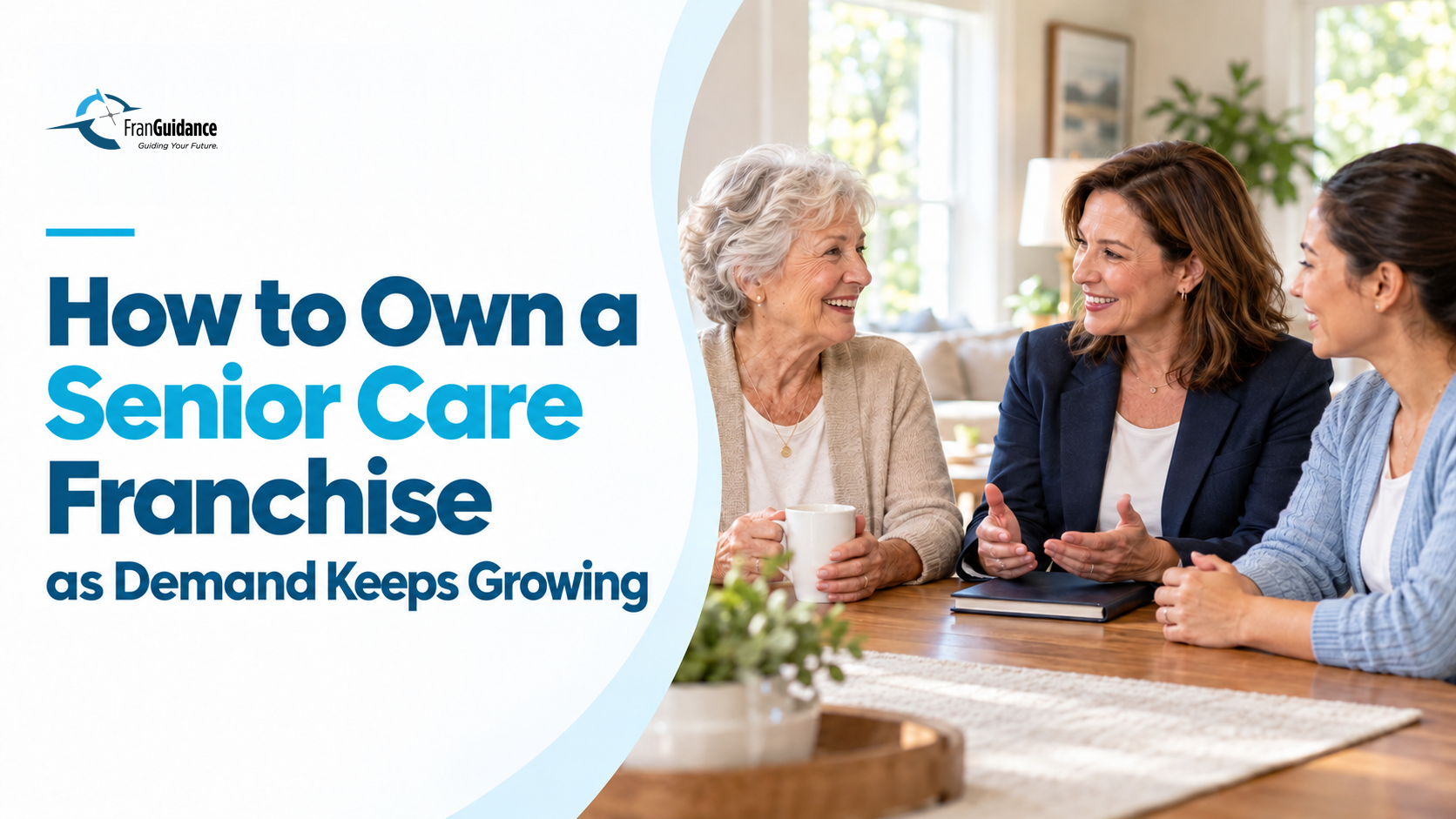
How to Own a Senior Care Franchise as Demand Keeps Growing

I help corporate professionals figure out whether a senior care franchise suits their goals, then prepare them for franchisors who screen candidates more closely here than in almost any other category.

4.9
★★★★★
Based on 127 reviews

About Senior Care Franchise Opportunities

Senior care franchise opportunities usually come up after someone has watched a parent or grandparent need help at home. That experience teaches you what families want: a person who shows up on time, treats Mom with dignity, and calls back when something feels off. A senior care business lives or dies on that promise, and you don't need a nursing degree to keep it.

I’m Irving Chung, a former franchise owner and a franchise consultant, and you can read how I got here on my story page. Senior care falls under the broader family of healthcare services franchises, and the senior care industry shows some of the clearest demand in franchising. More than 11,000 Americans are turning 65 each day in 2026, according to Kiplinger, as the baby boomer generation moves past retirement age across the country. Adults 65 and older made up 18.9% of Americans in 2025, and the U.S. Census Bureau projects 23.4% by 2060. The same Census report notes that 73% of adults 65 and older lived with two or more chronic illnesses between 2016 and 2019.

That growing senior population mostly wants to stay home. Pew Research Center found that 93% of adults 65 and older live in their own homes or apartments, which keeps demand strong for in-home care services.

Senior care franchises run on very different business models. Some focus on non-medical home care, such as companionship, meal preparation, and light housekeeping in seniors’ own homes. Others add a specialty program for clients living with Alzheimer’s or dementia. A few pair in-home care with assisted living placement, helping families find the right community when staying home is no longer safe. Each model asks something different of you as an owner, from staffing to local referral networks. When we talk, I’ll show you which brands sit behind each model and how each one would shape your week.

My consultations cost you nothing. If senior care turns out to be the wrong move for you right now, I’ll say so plainly and help you find a franchise opportunity that fits better.

Is a Senior Care Franchise Right for You?

This model works well if you:
Have $50,000+ in liquid funds ready to invest

Cost depends on the brand and the care model. Each franchisor sets its own minimums for liquid capital and net worth, and I’ll help you see where you stand. Most candidates pair minimum liquidity of $50,000 to $100,000 with a U.S. Small Business Administration (SBA) loan, a home equity line of credit (HELOC), or a 401(k) rollover.

Want to lead a team rather than work shifts

Plenty of home care business owners run their office as an executive owner business, with a care coordinator handling schedules. Expect more hands-on weeks during launch. Your time goes to people and growth, not caregiving.

Take comfort in a proven playbook

Licensing and regulations differ by state and by care model, and care plans and caregiver screening leave little room for improvising. Owners who stay committed to a proven franchise system tend to build steadier offices.

Feel a personal pull toward caring for older adults

Families notice the difference between routine help and compassionate care within the first week. Franchise owners who feel that pull earn referrals faster and keep caregivers longer.

This probably isn't for you if:
You picture a business that runs without you

Your clients are elderly who can get hurt easily. Even with a strong manager, you stay the person responsible when a situation turns serious.

Your budget can't absorb a slow first year

Referral partners and a reliable caregiver roster take time to build. Plan for several months to ramp up before cash flow turns positive.

Late-night phone calls wear you down

A caregiver calls out sick, or a client falls at home, and your evening plans change. If you want a predictable schedule, look at another category first.

Senior care has been booming for a while just because there's lots of seniors... you have to have lots of compassion to get into that... Because you're dealing with human beings.

Corporate Leaders Can Own a Senior Care Franchise Without Clinical Training

Many of the professionals I speak with rule out senior care in the first five minutes. They picture scrubs and bedside care, when the owner's role looks much more like running a regional office.


Here's how the work divides in most non-medical models.

Caregivers deliver the care
They give seniors assistance with bathing, dressing, meals, and companionship. In medical models, licensed nurses take on the clinical side, and franchise owners manage the compliance around them.
You build the company
Your week goes to recruiting, family consultations, and referral relationships with physicians, hospitals, and senior living communities.
The franchisor fills in the gaps
Training, compliance tools, local marketing, and the ongoing franchise support cover what you don't know yet.

Recruiting will test you more than anything else on that list, because every home care franchise in your area competes for the same caregivers. The U.S. Bureau of Labor Statistics (BLS) projects about 760,500 openings each year for home health and personal care aides from 2025 to 2035. In its 2026 home care benchmarking report, Activated Insights President Todd Austin said, “The agencies pulling ahead this year aren’t necessarily the ones with more resources.” The same report found that caregiver turnover has stalled even as shortages ease, which makes retention one of the biggest challenges in home care.


Retention decides whether you build a thriving business that keeps providing high-quality care, or spend every month refilling shifts. Simple recognition, steady schedules, and fair pay go a long way. That challenge rewards anyone who has built and kept a team in the corporate world. See which skills carry over into franchise ownership.

"We want you to focus on the business, not work in the business. In senior care... you don't have to be the one changing diapers, but... you have to be the one available if there's an issue."

Irving Chung, Franchise Consultant and CEO, FranGuidance.

What Senior Care Franchise Ownership Asks of a Former Executive

Testimonials

Hear from candidates I've guided through the franchise search.

Glen S.

★★★★★
★★★★★

It was a pleasure working with Irving as he helped guide us through the process of investigating and ultimately buying into a franchise business. His knowledge and expertise...

Justin S.

★★★★★
★★★★★

Irving's approach is genuine, professional, and completely dedicated. He goes above and beyond to invest ensuring his clients receive world class service. I highly recommend Irving...

Vince G.

★★★★★
★★★★★

Irving is an outstanding professional, consultant and advisor. I engaged with Irving as I transitioned out of the military after a 15 year career. Together we researched my market...

Stacey H.

★★★★★
★★★★★

Irving was just what I needed. He talked me through the ins and outs of franchising patiently, informatively, and confidently. He won my wife over with facts and examples...

Joe S.

★★★★★
★★★★★

The transition from a corporate job to working for myself was a bit scary. Working it through with Irving was so comforting knowing he made the move successfully himself...

Rob E.

★★★★★
★★★★★

I knew I wanted a second stream of income and wasn't sure of my options. Irving introduced several franchises designed for semi-absentee ownership. He gave me the inside track...

Sally W.

★★★★★
★★★★★

If you are looking to make a change, I highly recommend working with Irving. His insights and guidance were invaluable during my transition when I got laid off...

Brett S.

★★★★★
★★★★★

Irving somehow found me on LinkedIn at a time when I was doing a bit of soul searching regarding a career change after almost 30 years in HR / Oil & Gas. He introduced me...

Why an Insider Guide Changes Your Senior Care Franchise Search

The senior care industry rewards owners who choose carefully and punishes those who choose fast. Services for older adults also rank among the fastest-growing parts of the U.S. job market, with the BLS projecting 625,400 new jobs from 2025 to 2035, the most of any detailed industry. That growth draws a crowd of companies into the sector, and each franchise offering asks for a different kind of owner.

Twice a year I sit down with healthcare franchise CEOs, so I hear what never makes it into a brochure. Here’s what I help you learn before you commit:

How a brand actually helps owners recruit caregivers, beyond a job board login.

Whether the model fits your capital and your life. A home care office and an assisted living facility both count as senior care, but they demand very different owners.

What a franchisor’s approval team wants to see from a first-time owner, including a realistic hiring plan.

Where the warning signs sit, from saturated territories to low franchisee satisfaction.

A list is worthless... What you need to understand is the nuance to selection.

Book Your 15-Minute Discovery Call

Senior Care Franchise Myths vs. Reality

REALITY: Owners hire and lead caregivers. Your days go to families, referral partners, and your team, while the franchisor's care standards and training guide the hands-on work.
REALITY: A companion care office, a placement service, and an assisted living facility share a label and little else. Some entrepreneurs even run a home care office as a semi-passive franchise once a strong manager is in place, while other models need the owner nearby every day.
REALITY: The senior population keeps growing as baby boomers age, yet clients rarely become the bottleneck in this industry. Caregivers do. Home health and personal care aides earned a median of $35,800 in May 2025, according to the BLS, compared with $50,980 for all workers. Owners who make retention their main job tend to pull ahead.
REALITY: Size tells you about a brand's reach, not about your territory, the community you'll serve, or your fit. The International Franchise Association (IFA) reports that healthcare has grown into the third-largest segment of franchising since the pandemic, so you'll have plenty of systems to compare. Read each franchise disclosure document (FDD) and call its franchisees before you decide.
REALITY: Seniors need care services in any economy, but families still count every dollar. Only 21% of adults 65 and older carry long-term care insurance, so most care hours come out of family budgets.

Your First Senior Care Franchise Conversation Takes 15 Minutes

On our first call, we'll cover four things:

Which senior care model fits you

Maybe you cared for a loved one and want a career built on that experience, or you’ve set aside entrepreneurial dreams for years. We’ll sort out whether home care, home health, senior placement, or assisted living suits your strengths.

How franchisors will size you up

Senior care brands look past your bank balance. I’ll show you how they weigh empathy, management experience, and your plan for hiring caregivers, and how to present yourself well.

What your budget can realistically support

Investing in this sector pairs a commercial franchise senior care opportunity with work that touches real lives, but the math still has to work. We’ll look at what you can afford and what your market can sustain.

Whether the timing makes sense

You might be ready to move this quarter, or you might need another year of saving first. Either way, you’ll get a straight answer and no pressure. This call makes an easy first step.

I'm not here to sell you. I'm here to advise you.

No ranked lists. No sales pressure. Just candid guidance from a former franchise owner whom franchisors pay, so you never do.

Newsletter

Follow Us